OpenAI 'ın küre paketleme sonucunun ambalajından çıkarılması
Özgün başlık: Unpacking OpenAI's sphere packing result
OpenAI announced that they’ve solved ten open mathematical problems , including an improved Cohn-Elkies bound for sphere packing.
I briefly worked with Henry Cohn on computational experiments for sphere packing as an undergraduate. Sphere packing is notorious for hard open questions. Maryna Viazovska earned a Fields Medal in 2022 for work in dimensions 8 and 24.
However, you may be surprised at how approachable some of the basic results are. An amateur mathematician can get close to understanding both OpenAI’s latest advance and Viazovska’s work. Sphere packing also contains beautiful structures that link seemingly unrelated areas: discrete geometry, Fourier analysis, linear programming, and string theory.
Sphere packing features highly symmetrical structures like the E8 lattice, visualized here with a Coxeter projection.
People more qualified than me ought to judge whether this represents a “Move 37” moment for math, but in the meantime, it’s worth appreciating some of the inherent beauty of this field and the new results. Read on for a quick primer.
The sphere packing problem asks a deceptively simple question: what’s the largest fraction of space you can fill with equal-sized balls that don’t overlap? One motivation for studying this problem is error correcting codes , since an optimal packing is also an optimal code.
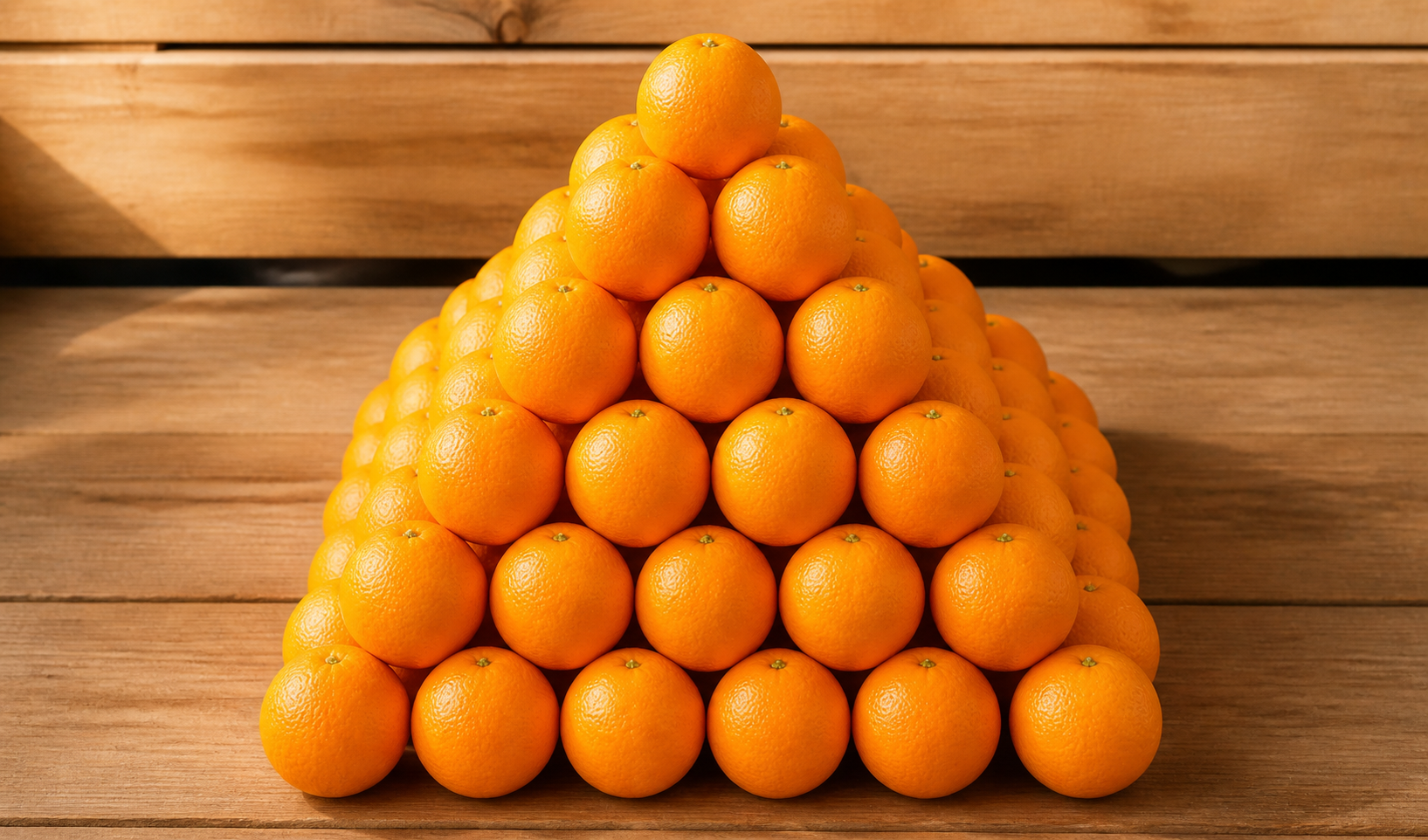
In 3D, sphere packing is a bit like stacking oranges in the grocery store. The intuitive choice, a pyramid, turns out to be optimal.
However, proving optimality only happened in 1998 (the solution was guessed by Kepler in 1611).
What happens if we plot the best-known sphere packing density in each dimension? The result is surprisingly jagged:
Best packing known (red) against the Cohn-Elkies linear programming bound (tan). Packing densities from Henry Cohn’s survey of Maryna Viazovska’s proof , which is excellent and worth reading.
There’s no obvious way to interpolate a point from its neighbors. Knowing the answer in dimension 8 tells you almost nothing about 7 or 9. Not only that, our 3D intuition that good packings are crystalline fails starting in dimension 10, where the best known packing is 8% denser than the best known lattice.
Dimensions 8 and 24 are special: the best known packings (the E8 and Leech lattices) match the Cohn-Elkies bounds exactly.